
You should rotate your tires every 5,000 to 8,000 miles under normal driving conditions with standard all-season rubber. If you wait until 15,000 miles, the front pair wears out twice as fast as the rears and you’ll need a full replacement set years sooner than necessary.
Rotate tires based on driving habits
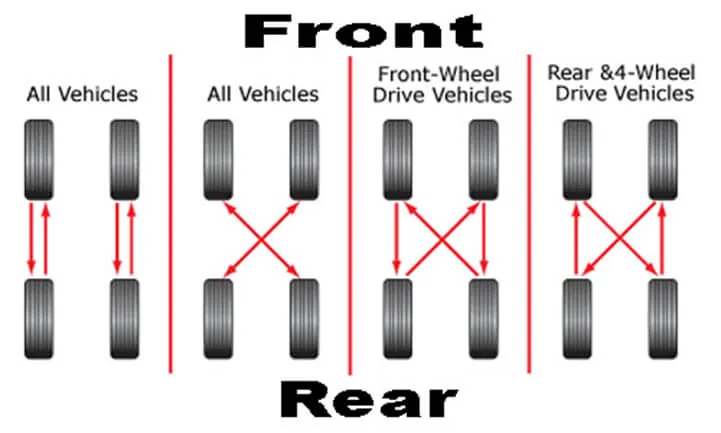
How often you rotate depends entirely on how hard you drive and what surface you’re on. The table below matches real driving habits to specific intervals so you aren’t guessing based on generic advice that assumes everyone commutes the same distance on smooth pavement.
| How you use it | How often | What tells you it’s due |
|---|---|---|
| Highway commuting only | Every 7,500 miles | Front tread looks shallower than rear |
| Mixed city and highway | Every 6,000 miles | Steering feels slightly less responsive |
| Heavy stop-and-go traffic | Every 5,000 miles | Visible wear difference between axles |
| Towing or hauling loads | Every 4,000 miles | Rear tires show cupping or scalloping |
| Off-road or gravel roads | Every 3,000 miles | Uneven shoulder wear appears quickly |
| Performance track driving | Before each event | Heat cycling accelerates rubber degradation |
Consequences of skipping tire rotation
Front tires on most cars wear 20% to 30% faster because they handle steering, braking, and engine weight simultaneously. Skip rotation long enough and this gap becomes permanent damage rather than something you can correct later.
After several thousand neglected miles, the front shoulders develop deep grooves while the centers stay relatively fresh. This uneven contact patch reduces wet traction and increases stopping distances noticeably during rain.
Eventually the wear becomes too severe to fix through rotation alone. You’ll face replacing two tires instead of four at once, which costs more per mile over the vehicle’s life. The National Highway Traffic Safety Administration notes that mismatched tread depths across an axle compromise handling stability during emergency maneuvers.
Ignoring rotation also masks alignment problems until they’ve damaged suspension components. What started as simple maintenance turns into costly repairs because the warning signs were hidden beneath uneven rubber.
Signs your tires need rotation now
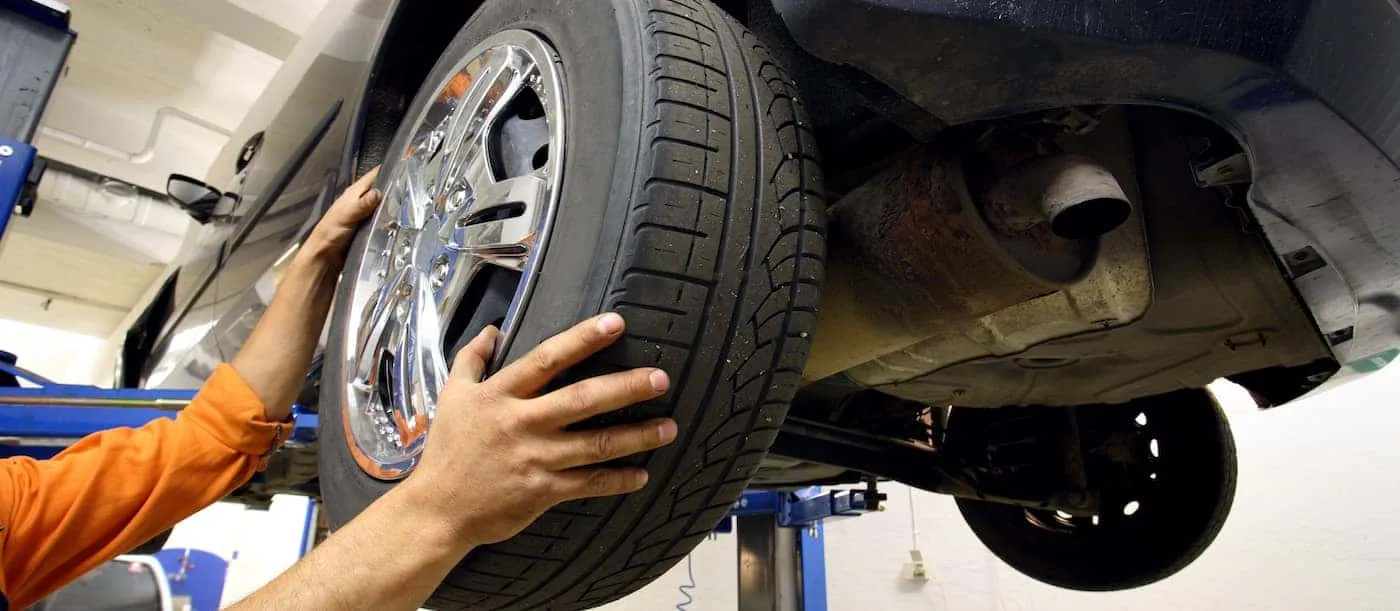
- Front tread depth measures noticeably less than rear when checked with a gauge at three points across the face.
- Steering wheel vibrates at highway speeds but balances fine, indicating uneven wear patterns rather than weight issues.
- Car pulls gently to one side on flat straight roads despite proper alignment, showing asymmetric shoulder wear.
- Outer edges look significantly smoother than center ribs when you run your hand across the surface.
- Noise increases gradually over weeks rather than appearing suddenly, suggesting progressive cupping from delayed service.
- Last service sticker shows mileage beyond your current interval by more than 1,000 miles.
- Visual inspection reveals feathering where tread blocks are sharp on one edge and rounded on the other.
Time and effort for each rotation
A professional shop completes the job in 30 to 45 minutes including inspection and torque verification. You’ll spend about an hour total when accounting for travel and waiting, making it easy to combine with an oil change.
Doing it yourself requires a jack, four jack stands, and a calibrated torque wrench plus roughly 90 minutes of careful work. The physical demand isn’t extreme but lifting wheels repeatedly strains your back if you rush or skip safety steps.
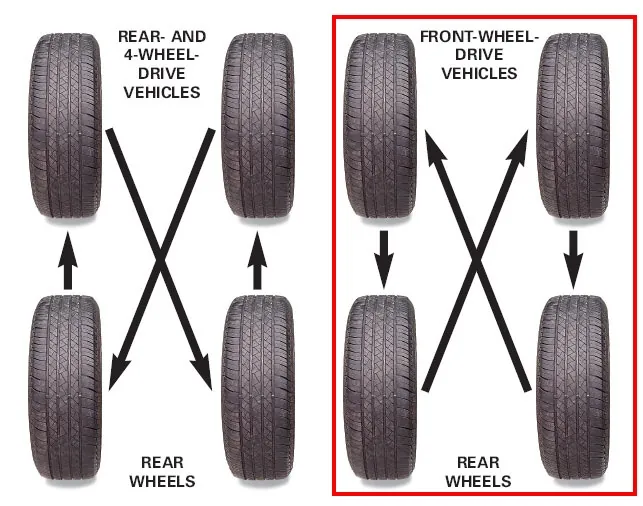
The cost varies widely by location and shop type, so check your local provider’s posted rate before committing. Dealerships often bundle it free with scheduled service while independent shops charge separately. Your owner’s manual specifies the exact pattern your vehicle needs, which affects labor time slightly.
Habits that extend rotation intervals
- Maintain manufacturer-specified pressure monthly since underinflation accelerates shoulder wear and makes rotation urgent sooner.
- Get wheel alignment checked annually because even slight toe misalignment creates drag that no rotation schedule can fully offset.
- Avoid aggressive cornering and hard braking when possible since these forces concentrate wear on specific tread zones.
- Store seasonal tires properly off the vehicle to prevent flat-spotting that mimics rotation-neglect damage.
- Choose touring or grand-touring compounds over performance variants if longevity matters more than grip, as softer rubber degrades faster regardless of maintenance.
Frequently asked questions
Can I rotate my own tires safely?
Yes, if you have proper jack stands and follow your manual’s lift points exactly. Never rely on the emergency jack alone since it’s designed only for roadside emergencies, not sustained support. Without correct equipment and torque specs, the risk outweighs any savings.
Why do front tires wear faster?
They carry 60% of braking force plus steering loads and engine weight in front-wheel-drive vehicles. This combination scrubs rubber during every turn and stop. Rear tires mostly just roll, so their wear stays minimal until rotation evens things out.
How long does a rotation take at a shop?
Most shops finish in 30 to 45 minutes once your car is on the lift. Total visit time runs about an hour including check-in and payment. Call ahead during peak seasons since wait times can double without appointments.
Is it safe to skip one rotation cycle?
Skipping once is usually fine if your tread wear still looks even across both axles. Check depth at multiple points before deciding. If any spot shows significant uneven wear, proceed immediately rather than risking accelerated degradation.
What happens if tires are never rotated?
Front tires wear out completely while rears remain nearly new, forcing premature partial replacement. Handling degrades progressively as the contact patch shrinks unevenly. Eventually the wear pattern becomes irreversible and requires full replacement instead of continued rotation.
Does AWD change the rotation schedule?
All-wheel-drive systems often require stricter adherence to 5,000-mile intervals because mismatched diameters stress the center differential. Check your owner’s manual for model-specific requirements since some manufacturers mandate exact patterns. Ignoring this risks expensive drivetrain damage beyond just tire costs.
How much does professional rotation cost?
The service is inexpensive relative to the alternative, with cost varying by shop and region. Dealerships frequently include it with oil changes while independents charge separately. Always ask upfront since advertised specials may exclude certain vehicle types or require additional purchases.
Next step for your tires
Check your current tread depth today using a quarter inserted upside down into multiple grooves across both axles. If Washington’s head is fully visible anywhere or fronts measure noticeably shallower than rears, schedule rotation within the next week. Stop driving and seek immediate professional help if you feel vibration, pulling, or hear unusual noise that worsens with speed.